Showing posts with label Long Delayed Echo. Show all posts

10 January, 2023

Audio delay - the unspecified parameter for ham radio transceivers

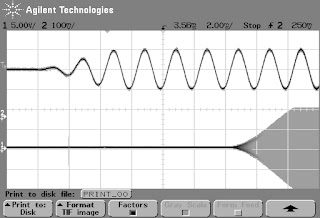
Elecraft K3: Upper trace is start of sidetone and
lower trace is start of RF ~15 ms later.
An amateur radio transceiver is not a precision measurement device. This is apparent when it comes to measuring time for your own round-the-world signal or when characterizing Long-Delayed Echos (LDE). One cannot just substitute onset of sidetone for the actual start of transmission of RF. Similarly there may be an unspecified delay between received RF and start of audio output on the receiver side.  

The main specification for ham radio transceivers is that the sidetone is synchronized with the keying. The delay to start of RF is only of secondary importance. All numbers should therefore be judged against the length of a dot which for instance at a morse code speed of 30 WPM is 40 ms. 

Here are some measurements for the Elecraft K3 and K2 that I did in 2021 for a presentation on LDEs at the HamSci 2021 conference. A video of the presentation is also available: Long delayed radio echoes – the illusive secret of the ionosphere

24 December, 2017

FT8 anomaly or long delayed echo?

My friend Alf, LA2NTA, has sent me these screenshots from when he has been operating FT8. The first image is when operating 10 meters and took place early in November.

Two of LA2NTA CQs being received by himself on 10 meter (in red)

It shows how his own CQ comes back to him at 10.54.00 and at 11.00.00 and is decoded in his own receiver. The echoes return at the time of transmission.

13 January, 2016

Magnetospherically ducted echoes in the San Francisco area

On 7. November 2015, several radio amateurs in northern California heard echoes in the 80 meter band. I was made aware of it by Jack, W6FB in Santa Clara, who recorded signals from K6YT some 25 miles away. According to W6FB, the echo effect was also heard north of Sonoma (several hundred miles north of him, reported by N6ZFO).

KM6I, Gordon, in Palo Alto also heard echoes of his own signals and recorded them. In his blog he analyzed the delay from the output of his transceiver and found 157 ms. He found that to be so close to the round-the-world time for signals of 138 ms, that he assumed that to be the cause.

I don't agree, so I took the location of W6FB at locator CM97ah (Santa Clara) as a starting point for computing delay. This is latitude 37.31 and longitude -121.96 and gives a geomagnetic latitude of about 42.5 degrees. Then I put it into my program for computing path length along geomagnetic field lines assuming a height of the reflecting ionosphere on the opposite side of 100 km. The result is shown in the figure and predicts a delay time of 126 ms. My estimate of uncertainty is +/-5 ms.

The delay value is slightly less than 138 ms and easy to confuse with a round-the-world path. The challenge with estimating delays like this from the signal is that amateur transceivers may have an unspecified delay between start of transmission and start of sidetone. Measuring on the audio output as done here, measures the sidetone, not the actual RF.

I discussed this source of error in my 2009 QST article "Magnetospheric ducting as an explanation for delayed 3.5 MHz signals." Therefore the measurement shown above may fit with 138 ms just as well as with 126 ms, it depends on the actual transceiver's delay.

Other properties of the echo, such as the amplitude of the echo which according to W6Fat times was louder than the direct signal, also point to the duct theory as the explanation.

Others have heard such echoes also:
Other posts on the theme: Magnetospherically Ducted Echoes or Medium Delayed Echoes
02 November, 2015

Radio Ghosts Have Haunted the Airwaves for Nearly a Century

“The starship hypothesis is a very interesting one, and the one which seems to be the most popular one on the internet,” said Sverre Holm, a professor of signal processing at the University of Oslo. “Such theories always excite our imagination, but it builds on a very poor data set. Unfortunately I believe it says more about human imagination than anything else.”

Although scientists have yet to settle on a final explanation for these mysterious echoes, Holm believes this is has less to do with a lack of scientific knowledge than a lack of willpower.

“I think that with today’s satellites and sensors, the mystery of Long Delayed Echoes (LDEs) could probably be solved,” he said. “What’s holding us back is most likely the problem is not considered important enough—it doesn’t occur often enough and doesn’t affect important enough forms of communications.”

These are excerpts from an interview in an article entitled "Radio Ghosts Have Haunted the Airwaves for Nearly a Century" on Motherboard Vice written by Daniel Oberhaus. It builds on a web page that I created some years ago after having spent days studying the archives from the 20's of professor Carl Størmer at the National Library in Oslo.

28 February, 2013

Long Delayed Echo on VOA Chinese Service

Thierry, F4EOB from Paris is still hearing strange echoes on the VOA Chinese service broadcasts. There isn't really any good explanation for this phenomenon.

Now during winter he is hearing it both on 13650 kHz from 9 to 12 UTC and on 21590 kHz from 9 to 11 UTC. The 21590 kHz transmission has been heard by him for a long time and I mentioned it here last year also. As then the echo is about 2 seconds. Thierry also made a youtube video of it with a recording.

The transmitter locations are in Asia. The 19 m band site is on the Mariana Island (Tinian) and the 13 m band transmitter is in Tinang in the Philipines.

In my blog last year I discussed possible explanations such as multiple transmitters or multiple round-the-world travel. But since the delay is so consistent and has had the same delay for such a long time, the probability that it is man-made is rather large.

Thierry tells me that this LDE can easily be heard with the WebSDR at the University of Twente in the Netherlands also. I would be curious to hear from people outside Europe who could compare the Dutch WebSDR with their own local reception and see if the same echoes are heard everywhere.

18 November, 2012

F/LA3ZA on Long Delayed Echoes


Laurent, F6GOX, who is one of the primary forces behind the ARP, Radio-Club de Paris, has written a nice little French-language presentation of me since I am a former member of the club. It also includes my interest in Long Delayed Echos (LDE).

Here he also talks about the presentation I gave for the Paris club of radio amateurs on 18 March 2009 on this subject during my year-long stay in Paris. That was a very nice evening which I remember with pleasure.

I also talked then about the interest that the French general Gustave Ferrié (1868 - 1932) took in this phenomenon (The link is in French, but read about Ferrié here in the English Wikipedia). There were French studies of LDEs in Indochina, Senegal, and Mauretania, French territories at the time, which he played a major role in.


Merci Laurent!

09 June, 2012

Medium delayed echoes

Medium Delayed Echoes or Magnetospherically Ducted Echoes (both MDE) are radio echoes delayed from 0.14-0.3 seconds. They represent a subset of Long Delayed Echoes (LDE) and is the only one of the five LDE effects discussed in "The Five Most Likely Explanations for Long Delayed Echoes" which is fairly well understood.

Here is a fascinating report of such echoes from G3ZRJ. His report is different from those of many others in two unique and very interesting ways.

02 June, 2012

More long delayed echoes

4.5 metre high UK acoustic mirror used as early warning system
during WW1. Not so relevant for Long Delayed Echos, but something
which definitely reflects well. Wikipedia Commons, Paul Glazzard
The mystery of Long delayed echoes is still without a scientific solution. With that I mean an explanation in terms of an effect which is testable, i.e. where one can predict the value of the delay and under what conditions it occurs.

It is likely that there isn't just one explanation, but several. I found it helpful some years ago to list all 15 possible hypotheses and then narrow them down to The Five Most Likely Explanations for Long Delayed Echoes. This list is now being referenced on the RSGB site for Long-delayed echoes (LDE) as well as in the Wikipedia article on the subject.

In this blog post there are examples of multisecond echoes on 21 and 27 MHz.

09 May, 2012

Unusual HF Propagation Phenomena

Earthrise from Apollo 8 (NASA)
My blog has just been updated by migrating posts from my old web site containing a collection of audio samples from unusual HF propagation phenomena. They range from round-the-world propagation (delay 138 ms) to ducted transmission in the magnetosphere (delay ~140-300 ms) ending with moonbounced 7 MHz signals (delay 2.39 sec).

The posts are:

01 March, 2010

Magnetospherically ducted echo

Magnetic field lines in the
magnetosphere (Ill. NASA)
Signals in the 1.8 - 4 MHz range may pass the ionosphere and be ducted in the magnetosphere out to a distance of several earth radii over to the opposite hemisphere where they will be reflected on top of the ionosphere.

The round-trip time varies with the latitude of the transmitter, or to be more accurate with the position relative to the magnetic Equator. Typical delay times are 140 - 300 ms. At my location near Oslo, Norway, the expected delay is about 308 ms, but unfortunately I have yet to hear such an echo.

28 January, 2010

Moonbounced echoes on 6792.5 and 7407.5 kHz

Recently, a facility with big enough antenna (300 by 365 m) and high enough power (3.6 MW) was used to set a new record for how low in frequency one can go and still get echoes from the moon.

This was also done during the HAARP moonbounce experiment which encouraged radio amateurs to listen on 19 and 20 January 2008. At my location in Oslo, I only heard the direct signal from Alaska, but many in the US heard good moon echoes.