Showing posts with label signal processing. Show all posts

28 April, 2025

The magic of adaptive filters in amateur radio

Examples of a speech signal (top),
a sinusoidal, and noise (bottom)
Radio amateurs have been using adaptive noise reduction and adaptive notch filters for decades. They came with the advent of audio digital signal processing. 

Few however, understand how different they are from ordinary frequency selective filters and for many they appear to do something magic, very different from ordinary filters.

05 March, 2025

Why is speech quality so poor in DMR, D-STAR, and System Fusion?

Example of a speech signal which transitions
from an unvoiced to a voiced sound
Digital VHF and UHF communications is increasingly popular among radio amateurs using DMR, D-STAR and System Fusion. 

Very few radio amateurs, however, have much understanding of the signal processing required to compress a speech signal so it can be transmitted with the low bit rates available. Here is an attempt at an explanation.

12 October, 2024

The Little Known Fourth Method of Generation of Single-Sideband Signals

Envelope Elimination and Restoration, from Kahn 1952 
There is a method for SSB generation which is now becoming popular with digital signal generation and digital output stages. This is the Envelope Elimination and Restoration method or Polar Modulation method. The signal is interpreted as a complex signal in the polar format, i.e., with an envelope and a phase.

This method is receiving renewed interest among radio amateurs as it is used in the SSB implemention of e.g. the interesting QRPLabs QMX transceiver. 

In the QMX a single frequency signal (the phase) is generated in the digital domain and then phase modulated (upper branch of figure). It then has a digital output stage with very high efficiency as it only switches between on and off. The output stage is amplitude modulated with the envelope signal from the lower branch.This gives a much more efficient power amplification than is possible with the three conventional methods.

The three methods

How does it compare with other methods? In 1956, Donald K. Weaver, Jr. wrote a paper with title "A Third Method of Generation and Detection of Single-Sideband Signals".
10 January, 2023

Audio delay - the unspecified parameter for ham radio transceivers

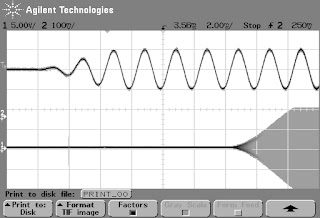
Elecraft K3: Upper trace is start of sidetone and
lower trace is start of RF ~15 ms later.
An amateur radio transceiver is not a precision measurement device. This is apparent when it comes to measuring time for your own round-the-world signal or when characterizing Long-Delayed Echos (LDE). One cannot just substitute onset of sidetone for the actual start of transmission of RF. Similarly there may be an unspecified delay between received RF and start of audio output on the receiver side.  

The main specification for ham radio transceivers is that the sidetone is synchronized with the keying. The delay to start of RF is only of secondary importance. All numbers should therefore be judged against the length of a dot which for instance at a morse code speed of 30 WPM is 40 ms. 

Here are some measurements for the Elecraft K3 and K2 that I did in 2021 for a presentation on LDEs at the HamSci 2021 conference. A video of the presentation is also available: Long delayed radio echoes – the illusive secret of the ionosphere

20 August, 2014

Digital Signal Processing

The Norwegian-language "The road to the international radio amateur license" came off the press this June. It is based on the RGSB International Amateur Radio Examination Manual from 2006, which RSGB graciously allowed us to use.

But the translation has been adapted on several topics. One example is the chapter on propagation due to the need in our country for more emphasis on propagation in polar regions and in mountainous terrain. Another is a completely new chapter on digital signal processing.