 |
| Fav 2 subset with 11 entries (Example in text has 9) |
- All, 50 screens
- Fav 1, 34 screens
- Fav 2, 9 screens
- Calendar, 13 screens
- Clocks, 27 screens
- Astro, 17 screens
- Radio, 12 screens
|
| Fav 2 subset with 11 entries (Example in text has 9) |


There is a total of 10 different bars and here are the two which are used in the upcoming version of the Multi face GPS Clock.


This is screen number 39 for this clock, all of them selectable by rotating a rotary encoder. The project, with Arduino Mega hardware and software is documented on Github, where the current release is v.1.6.0 (2023-04-14).
The display also shows the full name for the element corresponding to the second, as shown above for element 3 which is Lithium. It is located in group (column) 1 and period (row) 2.


The multi-face Arduino GPS clock is inspired by the Clock Kit from QRPLabs. It is an open source project on GitHub, and it now has support for many more languages in the newly released versjon 1.4.0. As a language nerd myself, I love fiddling with multiple languages and character sets.
The local language option is for display of day name in case local time is shown. The default is English for local time. No matter the choice for local time, English is always used for UTC day name. Here are examples:
French:


Main links for documentation

The Norwegian Ham meeting 2022 will take place 11-13 March near Oslo Airport Gardermoen. Norwegian and some Swedish radio amateurs will meet and the program is here (Norwegian). It will be nice finally to meet again!
I will give a presentation on Saturday morning: "An easy-to-build GPS clock for the shack".

The GPSClock from last month has now been updated and software version 1.10 1.1.0 is available on Github. The main upgrade is the possibility to use a rotary encoder for selecting display screen or clock face.
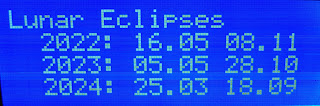
In addition a new screen showing Easter for the next three years, according to both the Gregorian (Western) and Julian (Eastern) calendars, has been added as number 22. The dates are shown in the Gregorian calendar:

Version 1 of my Multi Face GPS Clock is here, as open source software for the Arduino Mega. It has some 22 19 different display screens showing time, location, solar and lunar positions and rise/set times. It shows UTC time as received from the GPS satellites and local time where it automatically adjust for summer time. The initial screen, no. 0, is this:


Finally, over the last few weeks I managed to adapt lunarCycle.c to Arduino and get it to work as shown in the display here. My ambition is now eventually to publish this project on GitHub as I’ve had several requests for it.
The display here shows local time and date, moon phase on line 2, present moon elevation and moon azimuth on line 3, and the next rise time of the moon and at which position on the final line. Follow label ‘ Multi-face GPS clock’ below for more posts about this clock.


 |
| Arduino Nano, Si5351A clock generator, I2C LCD display, and rotary encoder. The GPS signal is connected to the plug to the lower left. |
 |
Local time, solar and lunar state
Line 1: Local day, date, time
Line 2: Sunrise, maximum solar elevation (actual solar angle during the day), sunset
Line 3: Civil dawn, local time at maximum solar elevation, civil dusk
Line 4: Lunar phase, arrow showing that it is rising, days since new moon
|

 |
161.3 cm
27.0° 347.7 m/s
|

