Showing posts with label audio. Show all posts

09 January, 2022

Magical speaker cables - part 2

Cable with large distance between the
conductors (Schnerzinger)
Part 1 of this article concluded that it is important to have thick enough cables in order to bring down the resistance. It also showed two examples of slightly more exotic cables, shown in the first two images here.

The first example had a large distance between the conductors and was placed on its own stand to get distance from the floor. It was designed to minimize capacitance between conductors. Another design criterion was to minimize the impact of vibrations created by the speakers themselves.
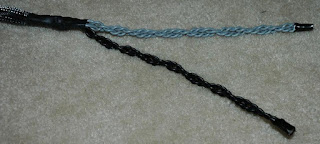
Twisted multi-conductor cable
The next example was a cable made by twisting together many thinner conductors, in this case a do-it-yourself cable. It was designed to have the least possible inductance and also to minimize the skin effect.

There is no shortage of science-based claims for how cables affect sound. There are so many of them that this blog post, where my ambition is to say something about all of them, gets to be a little longer than I would have liked it to be. If you are impatient, you may go to the end and just see the conclusion. For the curious, I will consider the claims one by one.

02 January, 2022

Magical speaker cables - part 1

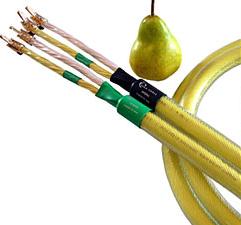
Pear Anjou speaker cable
I’m sure many have seen advertisements for speaker cables costing thousands of dollars. Some take this very seriously while others consider it to be pseudoscience. 

What should one believe? Here I want to help clarify the concepts.

A climax in the cable dispute may have been reached in 2007 when the skeptic James Randi offered a reward of 1 million dollars if anyone could prove that speaker cables costing $2750 for a pair of 1 meter long cables provided any improvements. He was provoked by the claims of the Pear Anjou cables shown in the image.

17 December, 2013

Scratchy Tivoli Audio Model One

The Model One has been a huge success. But in many ways it is a daring retro design judging from all the features that are missing in this radio. I am thinking of features such as a customizable equalizer, a digital display, and memory presets. It just has a plain old analog tuning dial for FM and AM.

The radio could as far as I can tell just as well have been made in the 70's except for some of the IC's which are used. Actually it is easy to see the similarity with the even older KLH Model 18 from the 60's, and yes - Henry Kloss played a role in both radio designs. But that makes for easy repairs, such as a seemingly common fault in the FM tuning capacitor, which over time may develop contact problems.

13 October, 2013

The simplest possible AM transmitter

Here's a design for a 1 MHz amplitude modulated (AM) transmitter. I've been looking a while for something like this, a simple short range AM transmitter for the medium wave band, as I needed something for demonstration of my collection of old radios.

The result is the AM transmitter shown here in an Altoids tin on top of a Radionette Kurér radio. This is a portable tube radio from the 1950's. Several hundred thousands were produced, and it was exported from Norway to 60 countries. It is still popular among collectors.

The transmitter is as simple as it gets. The heart of it is a 1 MHz crystal oscillator in a can. Its 5 Volt power is modulated via an audio transformer, one taken from the output of a transistor amplifier (primary 147 ohms - secondary 3 ohms). I drive the modulator from my cell phone into the low resistance side of the transformer and get good audio when the phone's volume is set to maximum.

25 June, 2012

The 10 biggest lies in audio

Quad II Tube amplifier. (Wikipedia Commons, user Harumphy)
In the fall of 2000 The Audio Critic had an article listing the 10 biggest lies in audio.

The article is well worth reading even today although the scene has changed a little since it was written. It for sure makes you think.

Peter Aczel's points were:

05 May, 2012

Passive Crossfeed for iPhone

Some records just have too much stereo separation. This makes them kind of artificial to listen to with earplugs or headphones as the sound in the two ears is too different. This is where a crossfeed circuit has a role to play as it is designed to mimic the blending of the two channels that takes place when listening through loudspeakers.

As the head is smaller relative to the wavelength at lower frequencies than at higher, the shadowing is also smaller. Therefore there should be more blending of right and left below 1 kHz than at higher frequencies.