- On top, the high-band version, 20-10 m, with a revision 4 PCB
- In the bottom, the original 80-20 m version with a revision 3a PCB
18 February, 2023
QDX Twins 80-10 m
10 January, 2023
Audio delay - the unspecified parameter for ham radio transceivers
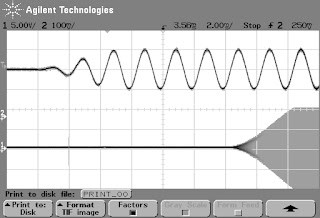
| Elecraft K3: Upper trace is start of sidetone and lower trace is start of RF ~15 ms later. |
The main specification for ham radio transceivers is that the sidetone is synchronized with the keying. The delay to start of RF is only of secondary importance. All numbers should therefore be judged against the length of a dot which for instance at a morse code speed of 30 WPM is 40 ms.
Here are some measurements for the Elecraft K3 and K2 that I did in 2021 for a presentation on LDEs at the HamSci 2021 conference. A video of the presentation is also available: Long delayed radio echoes – the illusive secret of the ionosphere
31 December, 2022
QDX with voltage regulator
20 November, 2022
W8BH clock with EU option
I cloned the software and modified it in two simple ways:
1. EU option
This is a backwards compatible version which can be Europeanized with formats for date and units. It also has possibility for removing the display of the battery icon, when running from a USB supply.
New boolean variables to set:
- US_UNITS - if false: m, kmh, Little-endian date with '.', if true: feet, mph, Middle-Endian date with '/'
- BATTERY_DISPLAY - true: as original code, false: no display of battery icon and status
03 November, 2022
Planet positions for the Multi Face GPS Clock
- Azimuth and elevation for inner and outer planets relative to your present location. The inner planet screen shows Venus and Mercury and alternates also every 10 seconds between showing the position of the sun and the moon. The % illumination is also shown along with an estimate of apparent magnitude
- The combined local time and UTC display now has an option to show ISO week number, defined to start on Mondays. (It is my understanding that the week number in the US is different, as Sunday is the first day of the week)
- A new calendar screen now shows Gregorian (western), Julian (eastern) as well as Islamic and Jewish dates. The calculation of the Jewish calendar is tough for the Arduino Mega and takes some 5-6 seconds
- A screen showing GPS Info has also been included. This screen shows the number of satellites in view (line 0), the number of satellites in use for position fix and their average signal to noise ratio (line 1), the mode and status indicators (line 2), and the Horizontal Dilution of Precision, Hdop, and its characterization in plain text (line 3).
26 August, 2022
QDX on 17 and 15 m: Receiver
The latest firmware, version 1_04, has a new "Band Configuration" screen where one may configure the list of supported bands. It is the intention that higher bands will eventually be supported.
I am not so interested in 80 m, so I wanted to see if I already now could get the receiver to work on 17 m and 15 m. With reference to the schematics, I modified the input filter's inductor, L12.
07 August, 2022
French, Spanish, German, Icelandic, Swedish, ...
The multi-face Arduino GPS clock is inspired by the Clock Kit from QRPLabs. It is an open source project on GitHub, and it now has support for many more languages in the newly released versjon 1.4.0. As a language nerd myself, I love fiddling with multiple languages and character sets.
The local language option is for display of day name in case local time is shown. The default is English for local time. No matter the choice for local time, English is always used for UTC day name. Here are examples:
French:
23 June, 2022
Reversing the inductor in the Chinese QRP antenna tuner makes all the difference
That was even after I had replaced the two polyvaricon capacitors. The two screws for mounting each of the variable capacitors were too long. The result was that they interfered with the moving plates of the capacitor and I ruined both of them. There was no warning of this in the manual, so beware anyone who buys this kit.
Despite fixing this, it didn't really tune anything. I later learned that it probably works for low bands like 80 m as it is, but I didn't notice that. I thought maybe the toroid core of the inductor was of inferior quality, but never really investigated it, so it sat unused on the shelf for 7-8 years.