Showing posts with label WSPR. Show all posts

20 February, 2024

Svalbard, JW1ITS, in International WSPR Beacon Project

1000 spots over the last 2-3 days of reception.
Image from WSPR Rocks.
This month a new receiver station in the International WSPR Beacon Project was established near Longyearbyen, Svalbard. It is located at the Kjell Henriksen Observatory, at 520 m above sea level. This is a nice location for reception, but it is a tough place for outdoor antennas.

The receiver is an Airspy HF+ Discovery and software is running on a Raspberry Pi 4 and it is intended to run continuously 24/7. The receiver receives WSPR which was conceived by Nobel laureate Joe Taylor, K1JT. WSPR is run in a Coordinated band hopping schedule from 3.5 - 28 MHz, i.e. each frequency is received every 20 minutes.

10 July, 2021

Coordinated WSPR band hopping with the QRPLabs U3S

There is a recommended sequence for multi-band transmission on WSPR. It is given in the K1JT WSPR documentation. If enough receivers follow this sequence, then presumably letting WSPR transmissions also follow it, will increase the chance of detection. 

The recommended band hopping sequence cycles through 10 bands over a 20 minute period according to this table:

Band (m)   160  80  60  40  30  20  17  15  12  10
UTC Minute  00  02  04  06  08  10  12  14  16  18
            20  22  24  26  28  30  32  34  36  38
            40  42  44  46  48  50  52  54  56  58

The multi-band U3S is capable of adhering to such a sequence. There are however three considerations that need to be taken into account. 

03 March, 2021

QRPLabs 25 MHz TCXO performing well in the U3S

I have tried several oscillators in the U3S QRSS/WSPR transmitter from QRPLabs. First an analog devices DDS, then a Silicon Labs oscillator chip running from an ordinary 27 MHz crystal, and then QRPLabs own oven controlled oscillator. I thought I had managed to control the drift when I got the oven controlled oscillator. But then after a while it started drifting again. I didn't want to go through its rather cumbersome calibration procedure once more so I gave it up recently when the TCXO module became available. This tiny module is shown in the first image.

24 April, 2019

The Ultimate WSPR Spot - part 2

Being spotted by the designer of my WSPR transmitter must be the ultimate WSPR spot! Perhaps only surpassed by being spotted by the designer of the mode himself, K1JT, Joe as I was four years ago.

It is Hans, G0UPL, of QRPLabs who is the designer of both my U3 to the left (turned off) and the U3S to the right. The latter was the active transmitter at the time of the spot below.


By the way, this is a line from VK2TPM, Peter's excellent WSPR Watch app for Ipod.


12 April, 2018

Power regulator works as polarity protection

Step-down converter based on LM2596. Note the damaged chip
Ok, now I've done the test. My QRPLabs U3S runs off a 12 Volt power supply. There are two step-down converters, one for 5 Volts for the processor and another adjustable one for the power amplifier, if one can call 0.2-0.5 Watts a power amplifier. See picture of these voltage converters in this post.

I happened to make a new cable for 12 Volts which had the polarities inverted - and puff - there was a noise and absolutely no response from the U3S. I feared that I had blown the entire circuit. As my power amplifier was turned off, only the 5 Volts supply was affected and upon inspection I found that the voltage converter had a destroyed chip.

Since these step-down converter modules are so cheap on EBay, I had a spare. Luckily for me, the U3S worked as it should after the replacement. So the LM2596 can take a reversed polarity and sacrifices itself in order to protect the rest of the electronics. Nice!


This post first appeared on the LA3ZA Radio & Electronics blog.

27 December, 2017

QRSS experiments: FSKCW and Slow Hell

These last few days I've been experimenting with my QRPLabs Ultimate 2 and Ultimate 3s transmitting on 7 MHz. In addition to WSPR, the modes transmitted have been FSKCW with 6 second long dots, and Slow Hell with 17 second long characters. The result as received this morning can be seen on the display from the grabber of Les, G3VYZ in Northumberland, UK. This is a stack of 6 consecutive 10 second frames as can be found on the QRSS grabber site of AJ4VD.

FSKCW and Slow Hell reception of LA3ZA at G3VYZ

My signal is on 7,039.870 kHz and has been set up with a FSK shift of 6 Hz. Power output was 0.2 W and the distance is about 890 km.

It works but the reception is much less reliable than for WSPR, which is not so unexpected. At the same time the WSPR signal was received all around Northern Europe (G, GM, DL, ON, OE, LX, LA, OY, OH, PA, SM) as well as on the Canary Islands, 3930 km away.

23 February, 2017

Comparing two antennas with WSPR

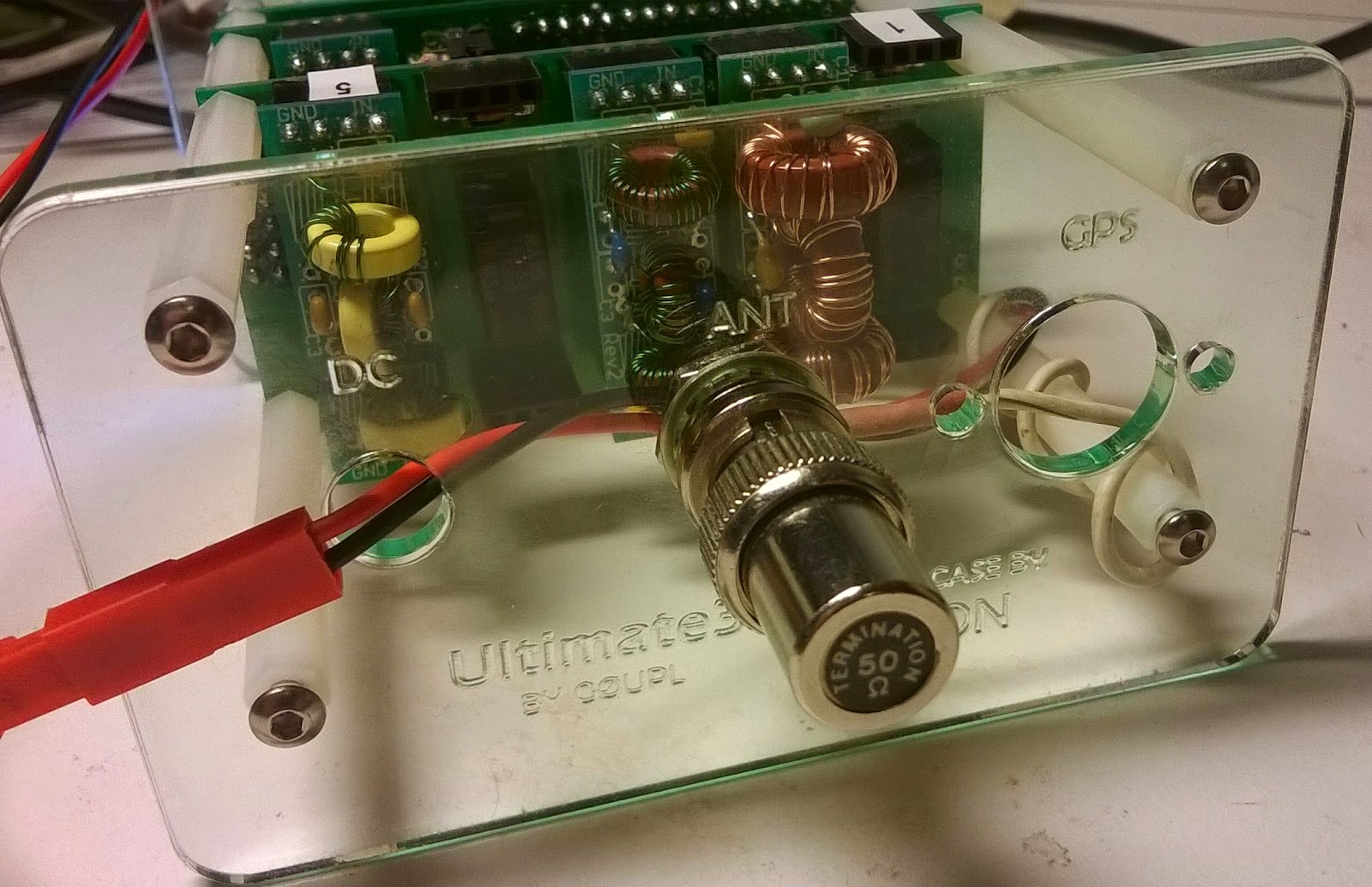
Ultimate 3S with 5-band relay module in front,
variable LM2596 power supply (with voltmeter) for
the power amplifier behind left,
a variable LM2596 supply set for 5 Volts for the Ultimate 3S
in the middle, and the antenna switch to the right in the back.
WSPR - The system for Weak Signal Propagation Reporter makes it easy to compare antennas if your transmitter can instantly switch antennas. The system shown here can send on antenna 1 for almost two minutes and then switch immediately to antenna 2 for the next transmission.

The Ultimate 3S already has software that supports that and application note 3 from QRPLabs (Controlling additional relays using the Ultimate3S “Aux”) describes how. I built mine following that note and the experience from EA1CDV.

The circuit is controlled from pin D7 and consists of a transistor, a relay, a resistor and an electrolytic capacitor. In addition I have two LEDs that indicate which antenna which is in use. In the first picture the green LED in the back right under the BNC antenna connector shows that antenna 1 is connected.

17 May, 2015

The ultimate WSPR spot

A spot reported by K1JT must be the ultimate goal for the WSPR mode. K1JT, Joseph Taylor, is the Nobel laureate who first developed this mode and other related two-way modes like JT65 and JT9.

My 0.1 W 21 MHz WSPR transmitter regularly makes it over the Atlantic, but never before to K1JT. The SWR was something like 7:1, but apparently that works fine, both for the transmitter and for radiation.

The antenna is a 13 m doublet oriented with the broadside facing East-West (the EU spots in the figure are from my Ultimate 3 on 21 MHz with another antenna and at another location). I feed the doublet with 450 ohm ladder line to a 4:1 Elecraft balun which is connected to the Ultimate 2 transmitter.


07 May, 2015

Ultimate software is up to date

As I have mentioned several times on this blog, I have thoroughly enjoyed WSPR modes ever since Hans, G0UPL came out with the first Ultimate QRSS/WSPR kit.

That means that I have three different versions of the kit. Since Hans has kept on updating the software and even published the compiled versions, it is also possible to upgrade even the old ones.

I have done that and the displays here show the Ultimate 3, the Ultimate 2, and the Ultimate 1 with the latest software.

It is possible to upgrade the chips in-circuit, but I found that it is simpler to remove the chip temporarily from the socket and move it to a simple veroboard with crystal oscillator components. It is connected to my Ebay version of the USBtinyISP.


29 April, 2015

First 475 kHz WSPR decoding

Tonight I made the first successful decoding of WSPR on the 630 m band. What inspired me was all the talk on the Elecraft reflector on the new synthesizer which in addition to having less phase noise, also allows the K3 to go below 500 kHz. I don't have that synthesizer, but the discussion reminded me of the low frequency converter I built many years ago. It converts 0-1 MHz to 14-15 MHz. Using the KXV3 transverter interface of the K3 it was easy to interface and get up and running.

The first signals I decoded are shown in the water fall above, and their origin in Germany and the Netherlands is shown in the next figure.

According to WSPRnet, PA0A's 2 Watt transmitter is 784 km away from me, and DK7FC's 1 Watt is 1164 km away.

The converter is quite simple and is based on a 74HC4053 switch used as a mixer with a 74HC04 for a 14 MHz oscillator. It is the design of SM6LKM, but with a different oscillator frequency and a simplified output filter compared to his. It is one of many small projects that I have built in Altoids tins.

The antenna used was my trusty old 80 meter horizontal loop which has been the main work horse for making my 8-band DXCC (more than 100 countries on all bands 3.5 - 28 MHz) possible. It is fed with ladderline into a 4:1 Elecraft balun in the shack.

Perhaps the next step is to finish the 475 kHz filter of my Ultimate 3 WSPR transmitter and see if others can receive me? That is going to be more of a challenge antenna-wise.


15 April, 2015

A beauty of a crystal radio

This past weekend during Hammeeting - the largest Ham rally in Norway - I met Per LA9DTA.

He showed me his beautiful crystal radio. It can be seen in the center of the table, with some close-ups below. The design has a printed coil and the whole design is made on a PCB which was shaped as shown in the image. It has a bandswitch and a Soviet low forward voltage Ge diode.

I fell for his design, but with the lack of longwave and medium wave transmitters here I am not sure if I would have much use for it. That is unless I set up one of my transmitter projects to support a radio like this.

I was demonstrating WSPR with my Ultimate 3 transmitter. It can be seen on the right hand side of the table. I wanted some fresh spots as I was giving a presentation later that day entitled "WSPR, JT65, JT9: Digital modes by Nobel laureates K1JT for HF DX with simple equipment". As I was spotted both on 40 m and 80 m I was happy with the performance. Per had also brought his Ultimate 3. Not the modified 11-band version, but just a plain one this time.

02 April, 2015

All continents in one night on WSPR

For me South America, Australia, and Africa are quite rare on WSPR. But they all heard my tiny 0.2 W signal the night between 31 March and 1 April in addition to North America, Asia and Europe. That's a new one for me and worthy a brag post on the blog, I think! Hopefully, it may also inspire others to try low power WSPR.

In Australia and South America I was heard on the 10 MHz band, in Africa on 21 MHz, in Pakistan on 14 MHz, while 7 and 10 MHz worked into Siberia. North American stations also heard me on the 7 and 10 MHz bands.

This was on my untuned 80 m horizontal loop fed with open-wire feeder and a 4:1 balun. This shows both that the bare-foot Ultimate 3 kit is very tolerant of loads with SWR much different from 1, and that WSPR gives amazing results.

27 January, 2015

0.2 Watts to South Africa

This is a new one for me: Norway-South Africa on 30 m WSPR in the middle of the night. Again I am amazed at what this mode can accomplish, and also what my little Ultimate 3 kit is able to do. 

The antenna used on my side was my trusty old 80 m long horizontal loop fed with a 4:1 balun and no tuning beyond that (SWR 7:1). Output power was from a single stage BS170 driven at 5 Volts, or about 200 mW in a 50 ohms load. In this particular antenna, the output is most likely much lower. 

ZS6KN is the only non-European station who has heard me this night on 30 m, with a marginal SNR of -27 dB.


24 December, 2014

Getting ready for 60 meter

I have never had any contacts on the 5 MHz or the 60 meter band. But I guess it's time for that now.

Both my K2 and my K3 support it and about 40 countries now have access to this band according to K1ZZ in his column "It seems to us" in this month's QST.

As a first test I ran my 0.2 W Ultimate 3 GPS-controlled WSPR transmitter over night and the image shows the result. I am using an 80 m long loop skywire antenna (horizontal loop) tuned to 60 m.

The results were encouraging with the best DX being UR5VIB in Ukraine at a distance of 1887 km. By the way, considering that it is 1093 km to LA9JO in the north of Norway, one sees the distortion in the map projection used for the Google map.

I have also operated the antenna as a vertical (about 8 meters) with top-hat loading by tying both feed-line conductors together and feeding it against a ground plane. The result is quite similar. The article by Dave Fischer, W0MHS called "The Loop Skywire" in QST November 1985 is the reference for both uses of the loop. The article starts out with this catchy phrase: Looking for an all-band HF antenna that is easy to construct, costs nearly nothing and works great DX? Try this one! This matches my experience exactly as this antenna has been instrumental for my 8 band DXCC.

07 August, 2014

WSPR on 5 bands

For the first time ever I have been spotted on all the five bands that my Ultimate3 QRSS/WSPR kit (G0UPL design) is transmitting on. This is after 2-3 days of transmitting.


Right now I am using the beacon for discovering if the bands should open up on 24 and 28 MHz. The other three bands, and especially the 14 MHz band, serve as references to tell me that the transmitter is working. My antenna is not so optimal so I would be surprised if I am spotted far outside Europe. It is an end-fed 5 m long half wave vertical dipole which isn't too bad for 28 and 25 MHz, and probably not very good at all on 21, 18, and 14 MHz.

24 April, 2014

Pulled out my dummy load tonight

Press image for a better view of the dummy load
Testing a transmitter means the use of a dummy load. Trying to be considerate, I don't want to cause unnecessary interference with my signals. So when I want to test my Ultimate 3 QRSS/WSPR kit I also pull out one of my dummy loads.

It measures just 9-10 mm across and is the size of a BNC connector. It is simply one of the many Ethernet terminations that I have lying around. Its built-in 50 ohm resistor is rated at something like 0.25 W. Considering that the kit outputs something like 200 mW that should mean that there is enough margin and no forced air cooling or liquid cooling is required.

04 February, 2014

Ultimate QRSS kits

I'm a great fan of Hans Summers (G0UPL) and his effort in launching kits for various slow speed modes. In fact I have all three generations of the Ultimate QRSS kits up and running. That includes the original single-band kit (30 m in my case, bottom in picture), as well as number 2 and 3, the multi-band kits.

The latest version, in the middle of the picture, has a nicer two line display, and it can also be fitted with a relay board. It makes it possible to jump between up to 6 different bands.

20 September, 2012

My first 24 hours on WSPR

My first beacon on 30 m, a free-running Ultimate QRSS kit (no GPS) has now been running for a full 24 hours using the Weak Signal Propagation Reporter (WSPR) mode. The figure comes from the WSPRnet page.

With an output power of about 150 mW to an 80 m horizontal loop it has not been possible to reach beyond Europe so far. Perhaps this will happen in the future with better conditions and/or with some more output power.

Added 26.9.2012: I made it for the first time across the Atlantic!
Timestamp           Call       MHz         SNR Drift  Grid      Pwr Reporter   RGrid      km      az
2012-09-26 00:50, LA3ZA, 10.140262, -26,   -2,   JO59fu, 0.2, WB2EEE, FN21xh, 5852, 290